Smart City vs Growing City: Understanding India’s Urban Future
Wiki Article
Have you ever wondered why some Indian cities feel like they’re constantly playing catch-up with themselves, while others seem to have everything figured out? You know the feeling — endless traffic jams, congested trains, utilities that struggle to keep pace with population growth. But then you visit another city, and you’re amazed by how seamlessly things work. Your metro ride is tracked in real-time. Traffic lights adjust to actual flow patterns. Even your water supply seems optimized.
The difference? You might be witnessing the clash between a growing city and a smart city — and understanding the distinction matters more than you’d think, especially if you’re considering investing in Indian real estate or just curious about urban development.
Let me explain what these terms really mean, why they matter, and how Navi Mumbai is attempting something genuinely fascinating: becoming both at the same time.
What Is a Growing City, Really?
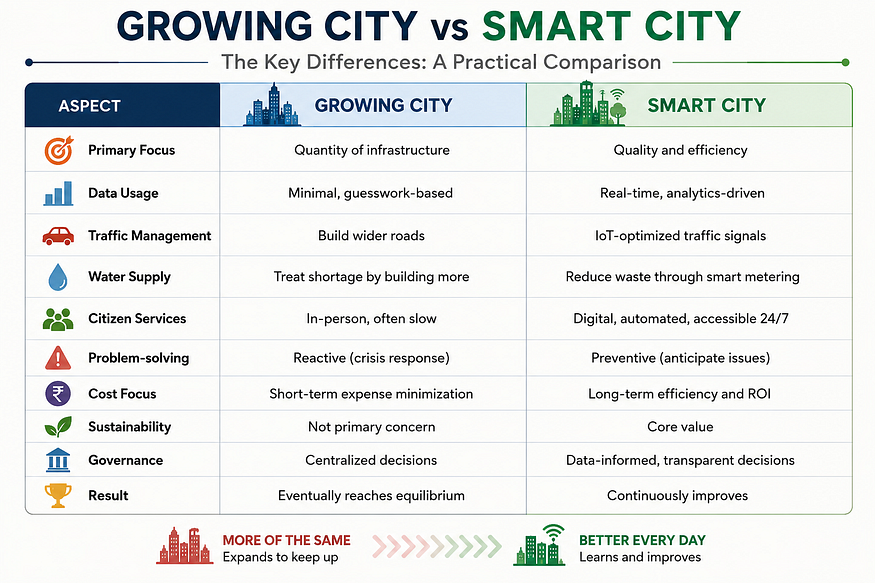
Think of a growing city like a teenager going through a growth spurt. It’s expanding fast — more people arriving daily, more buildings going up, more congestion happening. But growth doesn’t always mean sophistication. A growing city is primarily concerned with one thing: accommodating sheer numbers.
Growing cities typically exhibit:
- Rapid population influx — People move in faster than infrastructure can accommodate them
- Construction-focused development — The emphasis is on building more homes, more roads, more utilities (quantity over quality)
- Reactive planning — Solutions come after problems arise. The water runs out? Build more pipes. Traffic explodes? Build wider roads
- Traditional infrastructure — Basic utilities function, but they’re not intelligent or interconnected
- Visible chaos — You see it everywhere: traffic jams, water shortages, power cuts, overcrowded public services
- Cost-driven approach — Building more is often cheaper than building smarter
In a growing city, the fundamental question is: “How do we fit everyone?” It’s survival mode. The goal is to expand faster than the collapse happens.
Indian Examples of Growing Cities
Look at cities like Bengaluru (Bangalore) in the 1990s and 2000s, or even today’s Hyderabad. These cities experienced explosive growth. Companies set up IT operations, talent flooded in, real estate boomed. But the basic infrastructure couldn’t keep up. Traffic became a nightmare. Water became scarce. Power cuts happened regularly.
Or consider Gurugram in the National Capital Region. It grew from a small town to a corporate hub almost overnight, but you can still see the tension between explosive growth and inadequate planning. It’s not chaotic anymore, but it took years of struggle to catch up.
What Is a Smart City?
Now imagine a city where every system talks to every other system. Where data flows like electricity. Where decisions are made based on real-time information, not guesswork.
A smart city is fundamentally different. It’s not about building more — it’s about building better. It’s about using technology, data, and intelligent governance to solve urban problems at their root.
A smart city is an urban model that leverages technology, human capital, and governance to improve sustainability, efficiency, and social inclusion. Think of it as a living organism that learns and adapts.
Smart cities typically exhibit:
- Technology integration — IoT sensors, AI, data analytics, and communication networks are embedded throughout
- Real-time problem solving — Traffic signals adapt to actual traffic flow. Street lights turn on only when needed
- Data-driven decisions — Every decision is backed by actual data, not assumptions
- Sustainability focus — Environmental impact is measured and minimized. Energy is optimized. Water is managed intelligently
- Seamless connectivity — Different systems communicate. Your metro app tells you exactly when the train arrives. Your utility company knows usage patterns
- Citizen participation — Residents can report issues, access services, and participate in governance through digital platforms
- Preventive approach — Problems are anticipated and prevented before they become crises
In a smart city, the question is: “How do we serve everyone efficiently?” It’s strategic. It’s future-focused.
Indian Smart Cities Leading the Way
Ahmedabad champions green urban living, Surat advances with robust transportation systems, Pune revolutionises with smart governance, Bhubaneswar emphasises community-centric cityscapes, and Indore leads in waste management. These are cities that were selected under India’s Smart Cities Mission.
Let’s look at Pune as a concrete example. Pune has implemented ground-breaking initiatives such as digital classrooms, smart street lighting, and intelligent transit systems. The city focused on using technology to improve public services comprehensively. When you visit Pune, it feels organized despite being a major metropolitan area.
Surat is another fascinating case. The city has put in place smart water management systems, waste-to-energy facilities, and solar power generation. Instead of just building more treatment plants, Surat reimagined how to manage resources intelligently.
Bhubaneswar has introduced intelligent street lighting, waste management systems, and smart traffic management systems with an emphasis on integrated infrastructure and citizen services.
But here’s the thing: even these smart cities face a constant challenge. They had to build smart infrastructure into existing systems, which is incredibly complex.
Enter Navi Mumbai: The City Trying to Do Both
Here’s where it gets interesting. Navi Mumbai — often called “New Mumbai” or part of the “Third Mumbai” project — is attempting something unusual. It’s simultaneously a rapidly growing city AND striving to be a smart city. And it’s happening right now, in 2024–2025. A real estate developer Dr. Avinash Jagdale Name is Currently Very Popular in this region
The Growth Story
Let’s start with the growth part. As of 2025, Navi Mumbai boasts a population of approximately 1.63 million and holds the 6th position in the Ease of Living Index. That’s remarkable growth for a city that barely existed 30 years ago.
Navi Mumbai was conceived in the 1980s as a planned satellite city to relieve pressure from overcrowded Mumbai. But unlike many satellite cities that just become dormitories, Navi Mumbai is developing its own economic centers, residential neighborhoods, and commercial hubs.
The scale of development is staggering. ₹6,600 crore in tenders were awarded in 2024 for roads, bridges, underpasses, streetlights, and stormwater systems. CIDCO (City and Industrial Development Corporation), the authority managing Navi Mumbai, is simultaneously planning to build enough infrastructure for millions more people while trying to do it intelligently.
The Smart Infrastructure
But here’s what makes Navi Mumbai different. It’s not just growing chaotically. It’s being built with deliberate intelligence from the ground up.
The Navi Mumbai Metro System
The CIDCO launched a QR-based paper ticketing system for Navi Mumbai Metro Line-1 on 22 June 2025, which went live on 24 June. This move aims to enhance commuter convenience, improve fare management, and support the transition to a more efficient, technology-driven transit network.
Think about what this means. Instead of traditional tokens or paper tickets, you have a digital system. This isn’t just convenient — it’s intelligent. As of 24th June 2024, a total of 43,08,147 passenger journeys have been recorded since the commencement of the Navi Mumbai Metro. Every single journey is data. Operators know exactly where people are going, when, and how often. This data helps optimize routes, train frequency, and future expansion.
By providing high-capacity public transit, it reduces the reliance on private vehicles, thus easing congestion in the city. That’s smart planning. Instead of resorting to the age-old solution of building wider roads (which never actually solves congestion), they’re offering an intelligent alternative.
The Game-Changer: Navi Mumbai International Airport
Now, here’s something that really separates Navi Mumbai from typical growing cities. The upcoming Navi Mumbai International Airport is among the most ambitious infrastructure projects in India. Spearheaded by Adani Group and CIDCO, it is designed to ease air traffic congestion from Mumbai’s Chhatrapati Shivaji Maharaj International Airport.
The Navi Mumbai International Airport is set to become operational by July 2025 with a capacity of 90 million passengers annually and a design inspired by the lotus flower. Note that last detail — the lotus flower design is intentional. It’s not just about capacity; it’s about making the airport emblematic of smart, sustainable design.
This connectivity has had a direct impact on real estate prices in areas like Ulwe, Nhava Sheva, and Panvel, some witnessing a 10–15% appreciation within six months of MTHL’s launch. Growth is happening, but it’s strategic growth clustered around intelligent infrastructure nodes.
The Mumbai Trans Harbour Link (MTHL)
Here’s a concrete example of growth meeting smart infrastructure. The Mumbai Trans Harbour Link is a 21.8 km sea bridge that will cut travel time between Mumbai and Navi Mumbai to just 20 minutes. Instead of 2 hours of traffic, 20 minutes of seamless travel.
These bridges play a crucial role in linking Mumbai and Navi Mumbai, alleviating the traffic strain borne by the existing six-lane bridge, which struggles to accommodate vehicles converging from the 10-lane Sion-Panvel highway.
This is a smart solution to a real problem. Rather than endlessly widening the existing bridges (which would be expensive and never keep up with demand), they built an entirely new, innovative connection. And the impact is visible in property markets already.
Coastal Road Initiatives
The Kharghar and Ulwe coastal roads are designed to offer seamless connectivity to the new Navi Mumbai International Airport. These developments will integrate with the broader metro network and improve access to Atal Setu, while an elevated road along Ulwe ensures a direct connection to the MTHL interchange.
Notice the word “seamless” — and it’s not hyperbole here. Different transport modes (metro, roads, airport) aren’t just built in the same city; they’re designed to connect intelligently.
Affordable Housing and Social Infrastructure
One major difference between Navi Mumbai and traditional “smart cities” projects is the focus on inclusion, not just technology for the elite.
CIDCO is constructing 67,000 affordable homes under the Pradhan Mantri Awas Yojana, with 26,000 units completed by 2024, addressing housing needs. In mid-2025, CIDCO announced a draw for approximately 20,000–22,000 affordable homes in Navi Mumbai, focused on Economically Weaker Sections (EWS) and Low Income Groups (LIG).
This is crucial. A truly smart city isn’t smart if it serves only the wealthy. Navi Mumbai is actually building affordable housing at scale while simultaneously developing IT parks and commercial centers. That’s the difference between tech-for-profit and technology-for-inclusion.
Development Planning
The plan will focus on resolving current challenges and preparing for future expansion with key areas of focus including improved living standards, enhancing housing quality, and improving transportation infrastructure. This 20-year development plan isn’t reactive; it’s intentionally designed.
Why This Matters: The Navi Mumbai Model
So what’s actually happening in Navi Mumbai? It’s not choosing between growth and smart infrastructure. It’s trying to achieve both simultaneously.
A Growing City with Smart DNA
Unlike older Indian cities that had to retrofit smart infrastructure into existing systems, Navi Mumbai is being built with intelligence from the start. When they plan housing colonies, the infrastructure is already designed for smart metering. When they build roads, they include provisions for traffic management systems. When they construct the metro, digital ticketing is built in from day one.
Infrastructure-Led Development
With the Mumbai Trans Harbor Link now operational and the Navi Mumbai International Airport set to launch by end-2025, the region is rapidly emerging as a preferred destination for Global Capability Centers (GCCs). Smart infrastructure isn’t just serving citizens — it’s attracting businesses and talent.
Economic Intelligence
Real estate consultants believe NMIA alone could add 20–25% price growth over the next 5 years in surrounding micro-markets, particularly Juinagar, Panvel, Ulwe, and Taloja. This isn’t random real estate appreciation. It’s direct consequence of intelligent infrastructure planning.
The Hybrid Advantage
Navi Mumbai is unique because it combines:
- Growth momentum — Real demand, real jobs, real migration
- Smart infrastructure — Technology, connectivity, efficiency
- Planned development — Not organic chaos, but intentional design
- Social focus — Not just luxury, but inclusive development
- Sustainability — Green spaces, water management, energy efficiency
This hybrid model is what makes Navi Mumbai genuinely interesting. Most Indian cities struggle because they’re trying to add “smartness” to unplanned growth. Navi Mumbai is growing intelligently.
The Challenges (Because It’s Not Perfect)
To be honest, Navi Mumbai’s journey hasn’t been entirely smooth.
The formulation of the development plan has been ongoing for several years, encountering multiple delays. The COVID-19 pandemic and various administrative and technical challenges hindered its progress. Even with the best intentions, execution is complex.
There’s also the environmental question. Rapid development near coastal areas and Thane Creek raises questions about ecological impact. Smart infrastructure is great, but only if it’s genuinely sustainable.
And then there’s the human element. The NAINA (Navi Mumbai Airport Influence Notified Area) involves ₹5,000 crore worth of urban and industrial development across 170 villages, fostering self-sufficient cities for agro-farming, education, and IT. When you’re developing across 170 villages, rehabilitation and inclusion aren’t trivial matters.
What This Tells Us About India’s Urban Future
Navi Mumbai’s experiment offers important lessons:
1. Growth and Intelligence Aren’t Mutually Exclusive
You don’t have to choose between accommodating population growth and building smart cities. You can do both if you plan ahead.
2. Infrastructure Investment Matters
The billions being invested in MTHL, the airport, the metro, and roads aren’t wasteful. They’re catalysts. India’s infrastructure transformation is reshaping business corridors, and Navi Mumbai is at the heart of this evolution.
3. Technology Adoption Needs Vision
A QR-based ticketing system might sound trivial, but it represents a fundamental shift from analog to digital governance. These small decisions accumulate into genuinely smart cities.
4. Inclusion Matters
CIDCO is constructing 67,000 affordable homes. That’s not token charity. That’s building a city for everyone, not just the elite.
Report this wiki page